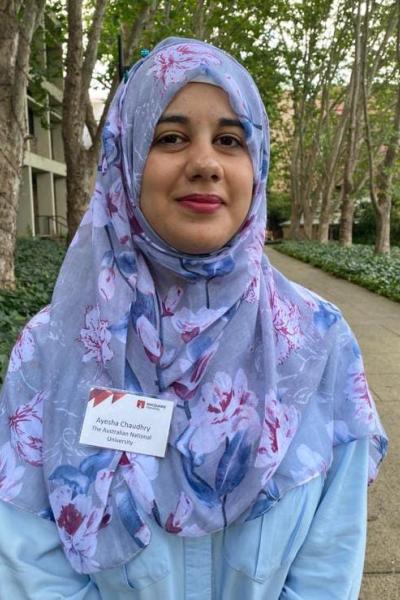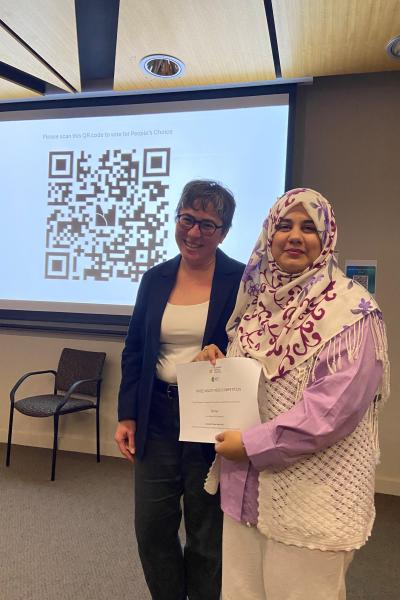
PhD student Ayesha Chaudhry challenges assumptions about Muslim women at ANU 3MT
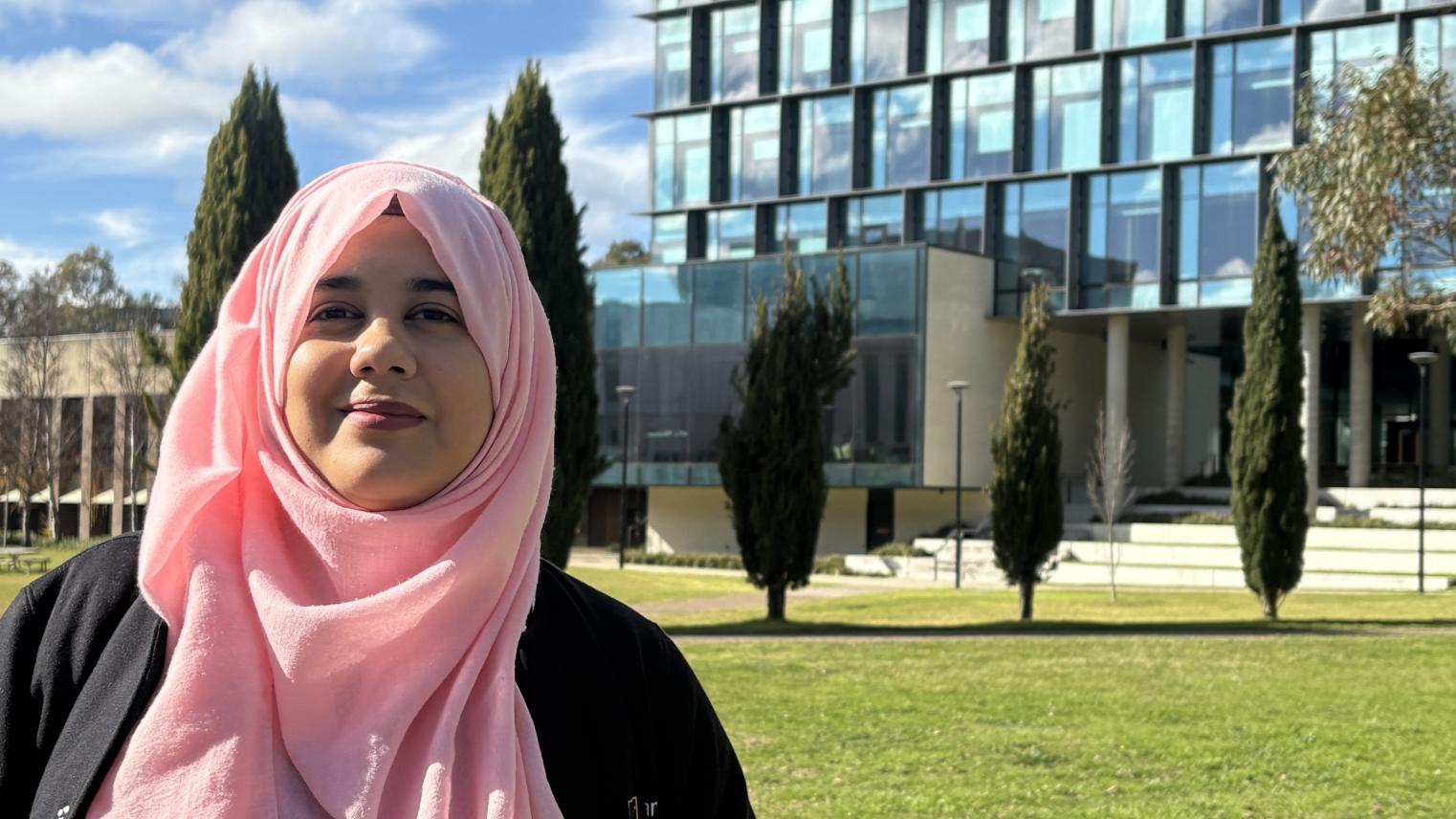
Behind every assumption is a story waiting to be heard.
That's the message Ayesha Masood Chaudhry hopes to bring to audiences when she represents the ANU College of Asia and the Pacific (CAP) at the Australian National University Three-Minute Thesis (3MT) Grand Final 2026.
A PhD candidate in anthropology from the School of Culture, History & Language (CHL), Ayesha's research explores the lives of single Muslim women in Rawalpindi, Pakistan, challenging simplified understandings of their experiences and revealing the complex ways they navigate identity, aspiration and social expectations.
Her 3MT presentation, Flipping the script, explores how marriage remains closely tied to social, economic, political and religious life while highlighting the many ways women negotiate these expectations as they pursue their own aspirations.
Drawing on phenomenological approaches to understand lived experiences, alongside the philosophical ideas of South Asian thinker Muhammad Iqbal and his concept of selfhood and self-actualisation, Ayesha examines how women navigate their lives within their social and cultural contexts.
At the heart of Ayesha’s research is a desire to highlight the complexity of Muslim women’s lives and move beyond simplified understandings of their experiences.
Rather than viewing women’s lives through a single lens, her work examines how identity, culture, social expectations and personal aspirations intersect within particular contexts.
One of the most memorable aspects of her research has been the openness of the women who shared their experiences with her.
“The openness with which these women welcomed my presence as a researcher has stayed with me,” she says. “I am incredibly grateful for the insights their lives have provided into the multifaceted experiences that Muslim women hold.”
Ayesha credits much of her PhD journey to the support she has received at CAP and CHL, particularly from her supervisor, Dr Eva Nisa, a respected scholar in the anthropology of Islam and gender.
Beginning her PhD during the COVID-19 pandemic meant Ayesha remained in Pakistan for two years before she was able to travel to Australia. She says Dr Nisa’s guidance and support were instrumental in helping her navigate these challenges.
“The support I received made overcoming those obstacles possible,” she says.
The research community at CAP and CHL has also shaped Ayesha’s approach as a scholar. She says the intellectual curiosity and encouragement within the School gave her the confidence to pursue ideas that did not always fit neatly within existing theoretical frameworks.
Like many PhD candidates, Ayesha says one of the greatest challenges of her doctoral journey has been learning to navigate uncertainty.
After experiencing burnout during her candidature, she took program leave and learned the importance of balancing persistence with wellbeing.
“A PhD is a long journey filled with many ups and downs,” she says. “Consistency is key, but it is also important to listen to what your body is trying to tell you. A well-rested mind makes for a happy PhD.”
Research like Ayesha's reflects the breadth of scholarship taking place across the College. From politics and public policy to languages, history, culture and society, higher degree research students at CAP are exploring the issues shaping the Asia-Pacific and beyond. Working alongside internationally recognised academics, they are encouraged to challenge conventional thinking, pursue new perspectives and communicate their research beyond academia. Opportunities such as the 3MT competition help students develop the confidence and communication skills to engage wider audiences and demonstrate the real-world value of their research.
For audiences watching her presentation, Ayesha hopes they take away one key message: understanding Muslim women’s lives requires attention to the complexity of their experiences and the contexts in which those experiences unfold.
As she prepares to take to the 3MT stage, Ayesha wants her research to encourage audiences to look beyond broad assumptions and listen more closely to the voices of the women whose lives she studies.
On 10 July, Ayesha will represent CAP at the ANU Three-Minute Thesis competition 2026 alongside fellow CAP PhD candidate Mary Joyce Bulao. Together, they showcase the depth and diversity of research being undertaken across the College while representing the next generation of researchers contributing new perspectives on the Asia-Pacific region and beyond.
The CAP community is invited to come along and support Ayesha and Joyce as they share their research on the national stage.