
Australian student visa refusal cuts short an educational journey
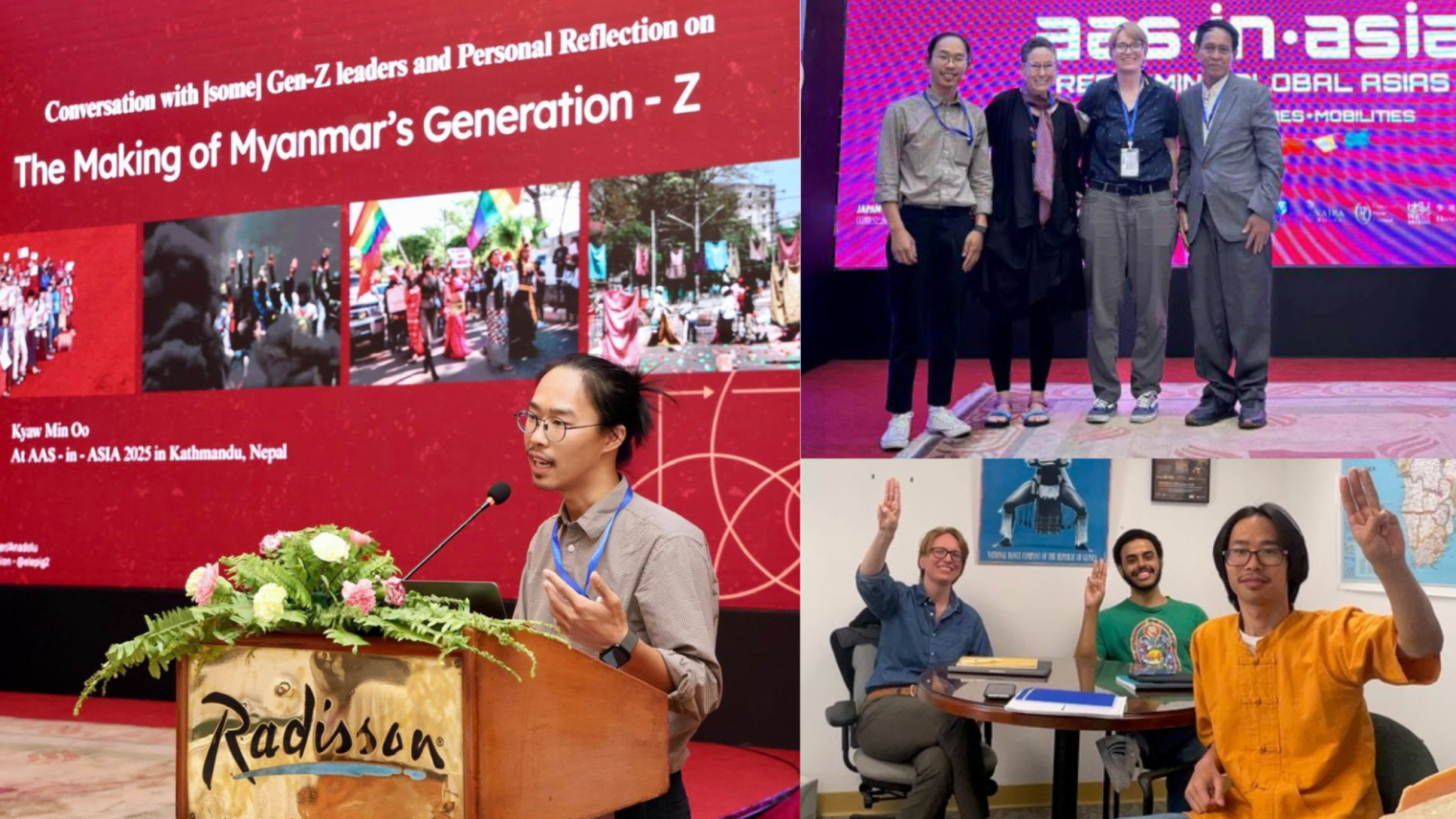
An open letter to Tony Burke, Minister of Home Affairs of Australia from Associate Professor Jane Ferguson, Anthropology and Southeast Asian History.
Since 2008, I have been a lecturer at the Australian National University. As such, I am well-aware that higher education is among Australia’s largest export 'industries.' It is a challenge and a privilege to work with such a tremendous variety of students. Every once in a while, I have the great joy and honour to teach a student with an especially compelling background story, someone who has overcome tremendous odds to further their own education, and possesses such creativity, dedication, and innate curiosity that I know they will do more with their education than I could possibly imagine. That amazing student is Kyaw Min Oo.
Kyaw is a 29-year-old Myanmar national from Shan State, Northern Myanmar. In 2024, Kyaw won a highly competitive scholarship to study a PhD in anthropology at the ANU, under my supervision. However, the Australian Department of Immigration decided that he is not a 'genuine student,' and used that rationale to reject his visa application. We are shocked and devastated by this ruling. With Kyaw’s permission, I share our story, as a matter of record, but also to present evidence that such short-sighted, discriminatory decisions are a detriment to the vitality of all our educational futures.
Kyaw’s Story
Kyaw Min Oo and I first met in 2022. I had accepted a one-year position as a Visiting Professor in Southeast Asian Studies at Ohio University, Athens, Ohio, United States. Kyaw was there on a USAID Lincoln Scholarship to study a Masters’ degree in Southeast Asian Studies.
Kyaw comes from a family of farmers in Shan State, the country’s northeastern province, making his academic journey to Ohio extraordinary. As a child, Kyaw attended underfunded rural government primary and secondary schools, where he was taught by rote methods in Burmese, his second language; his family speaks Shan at home. Securing a place at Yadanabon University put him in a tiny handful of students from his humble background. After completing his BA degree in Business Management, Kyaw followed his own values and commitment toward peace building and socially engaged humanitarian work. He worked for two years at Phaung Daw Oo Integrated Education School, providing accommodation and free education for children from impoverished backgrounds including those who had been orphaned by the ongoing conflict in Myanmar. After Phaung Daw Oo, Kyaw went to Rangoon to study at the Peace and Leadership Institute. He also worked for the Rangoon-based NGO Equality Myanmar (EQMM) doing Human Rights research-based advocacy and liaising with local grassroots organisations.
The February 2021 coup d’état has been nothing short of cataclysmic. Kyaw and his peers adamantly rejected the return to authoritarian rule. This was also a time when the US government supported select students to seek higher education in the United States, and it was through one such program that Kyaw secured a highly competitive USAID Lincoln Scholarship to study his MA at Ohio University. He flourished there, demonstrating tremendous drive and curiosity; colleagues told me he not only kept up with rigorous reading lists, but attended additional office hours meetings with his professors to learn and discuss ideas beyond the set curriculum. During my year at Ohio, Kyaw took both courses I taught, and I was a co-supervisor for his MA Capstone Paper. As a result, I got to know him and his work quite well. Beyond the classroom, Kyaw was an enthusiastic participant in campus cultural events, attended various guest lectures, and formed meaningful friendships with his cohort of students. He is a gentle person, quite bookish, but also an excellent collaborative learner. He was always welcoming to his peers and challenging ideas, demonstrating quiet leadership skills early on. Kyaw’s academic record was excellent, as he received A’s on nearly all his courses at Ohio.
Kyaw’s Journey to the ANU
Following the successful completion of his degree in Ohio, Kyaw returned to Southeast Asia, but to Chiang Mai Thailand, where he took up a position working for a Civil Society Organisation. We stayed in touch. When he expressed his desire to continue his studies in anthropology, I was delighted to continue to mentor him; my area of research is anthropology of Myanmar and Shan State in particular. For his proposed PhD research at the ANU, Kyaw framed a highly original and challenging topic, engaging spiritual ecosystems of Northern Shan State as well as agrarian change.
Kyaw’s proposed PhD research topic is both ambitious and crucial. It is ambitious in the sense that the village where Kyaw is planning to carry out fieldwork is multi-ethnic and a zone of contested sovereignty. His fluency in Burmese and Shan languages, and access to these communities is crucial because systematic, grounded cultural research is scant on these issues in Northern Shan State, particularly in the context of the post-2021 coup d’état and the proliferation of armed groups.
A brief aside: in July 2024, Julie Bishop, (then) ANU Chancellor and UN Special Envoy to Myanmar initiated a consultation with academic researchers affiliated with our Myanmar Research Centre. With much of the discourse about Northern Shan State monopolised by the political and military machinations of the various political organisations and armed groups, there is an appalling dearth of local people’s perspectives and analyses, let alone systematic work based on long-term, ethnographic research. Kyaw proposes to do just that. This kind of fine-grained research is what the international community needs to make informed decisions regarding future engagements with Myanmar as well as the region.
In October 2024, we were delighted to inform Kyaw that he was accepted to the PhD program in anthropology. By December, he was awarded a full scholarship. He lodged his visa application in early January. The prolonged visa process meant that he could not come to campus in time to start his PhD coursework. However, my colleagues at the ANU saw Kyaw’s potential and found alternative ways to support Kyaw and his PhD research trajectory. Kyaw joined the cohort of PhD students and participated in the Anthropological Theory and Methods courses remotely via Zoom. We met often and continued our directed readings for his research. He continued to refine his research question and expand his base of knowledge in anthropological theory and practice, as well as Southeast Asian studies writ large.
Visa Rejection
On July 22nd, over seven agonising months after he lodged his student visa application, Kyaw received a response: rejection. Although the processing agent noted his various educational accomplishments, including the scholarship to do an MA in Ohio as well as his receipt of a competitive scholarship to do his PhD studies at the ANU, the Department of Immigration ruled that Kyaw had failed to satisfy the ‘genuine student criteria’ (as per Clause 500.212 in Sch. 2 of the Migration Act, and Ministerial Direction No. 106). As the officer wrote in the rejection letter, they “hold significant concerns the unrest in Myanmar also presents as a significant incentive for the applicant to apply for a Student visa as means of obtaining entry to Australia for purposes other than to undertake the proposed courses of study.”
We certainly follow news in Myanmar with great concern. However, the presumption that Kyaw Min Oo is pursuing this education as a ruse is discriminatory, and frankly, an affront to the substantial educational preparation that he has done. The decision also flies in the face of the years of careful mentorship I have provided him. Rather than judging the merits of his case, or looking at Kyaw Min Oo as an individual applicant, the Department of Immigration has instead insinuated that he is trying to con the system.
Turning to my side of the situation, I am an academic who teaches anthropology and Southeast Asian history. I have dedicated my career and life work to research and education about Myanmar, as shown by my publications record, the courses I have taught and the theses I have supervised. This is my job, and put bluntly, the ANU pays my salary with the expectation that I put this expertise to good use. By denying me the opportunity to mentor students from Myanmar, a significant application of my work is stymied. Beyond this individual case of my own work and that of Kyaw Min Oo, there are long-term effects and principles that this short-sighted decision represents.
Education and Regional Cooperation Goals
Kyaw was not alone among Myanmar PhD students blocked by Australian student visa rejections. I know of at least four more from the past year. By rejecting students’ visa applications based on the political problems in their country of citizenship, the Australian government is punishing them for reasons well-beyond their control. This goes against the Australian Government’s stated policy which is to 'enhance our approach to our scholarships and fellowships programs across all countries in Southeast Asia, including ASEAN member states' ... and to forge 'new partnerships with universities and industry [that] will increase the pool of scholarships' (Australia-Southeast Asia Regional Development Partnership Plan/DPP 2024-2028, Objective 2, Page 12).
This past February’s Senate Inquiry report on 'Democracy and Human Rights in Myanmar' spelled out a specific recommendation that 'the Australian Government increase resettlement opportunities and alternative visas for education, research and employment opportunities for Myanmar asylum seekers and refugees and expand the Myanmar Australia Awards program.' A prime way to get started on this important path would be to reverse the visa rejections of these genuine students from Myanmar.
Therefore, I seek to appeal this ruling, based not only on the authenticity of Kyaw Min Oo as a student of anthropology and the value of his contribution to our educational program, but also the principles that this represents. Kyaw Min Oo’s educational opportunity is not simply a gesture of benevolence on the part of the ANU; on the contrary, Kyaw and students like him bring tremendous skill, creativity, and original research to our community. We must acknowledge that we are on an educational path together. The denial of a student visa due to the political circumstances in Myanmar is an affront not just to democratic principles, the idea of the 'fair go,' but also, to our educational future as part of a global community.
Very Truly Yours,
Jane M Ferguson
Associate Professor, Anthropology and Southeast Asian History
Images
Left: Kyaw Min Oo presenting at the AAS in Asia conference in Kathmandu, 2025; Top right: Panel at the AAS in Asia conference; Bottom right: Jane Ferguson with an Ohio University PhD student and Kyaw's classmate for a course Jane taught at Ohio in May 2022.